The Medium's Uncomfortable Mirror: Why The Last of Us Part II Changed Video Games Forever
Some works divide the history of a medium not because they sought consensus, but because they dared to break the pact of comfort between the work and the player. When Naughty Dog released The Last of Us Part II in 2020, the world of video games underwent a paradigm shift. It did so not simply by breaking visual records or offering a conventional sequel, but by risking the use of the medium's own interactive nature to confront the player with their own biases, hatreds and contradictions.
David Blake
On a technological level, Part II represents one of the most complex peaks of interactive software engineering. Its level of detail is not mere graphical ornament, but the product of an obsession with organic photorealism: real-time muscle deformation, the physics of air moving through foliage, sound propagation adapted to each space and context-sensitive physics that make every encounter feel visceral and unpredictable.
However, the game's true technological breakthrough lies in something even more significant: making video games accessible to everyone. With more than 60 meticulously integrated accessibility options, which allow people with visual, hearing or motor disabilities to complete the experience from start to finish, Naughty Dog not only set a new industry standard but also showed that AAA design can be truly universal.
While many narrative games water down their gameplay so it doesn't get in the way of the story, The Last of Us Part II elevates it. The cycle of combat, stealth and survival doesn't feel like a mechanical loop, but like a desperate fight for survival, especially on the most challenging difficulty settings. The introduction of jumping, the ability to crawl prone on any surface, level design built around vertical micro-hubs and an Artificial Intelligence whose enemies call out to one another by first name turn every encounter into a combat scene of almost physical intensity. Killing is neither fun nor gratuitous; every blow, gunshot or enemy kill carries a sonic and visual weight designed to disturb the player, so that the game's mechanics constantly reinforce the script's thesis.
Sony's exclusive catalog has frequently used guilt, the weight of violent acts and personal tragedy as narrative engines. However, while iconic titles such as Shadow of the Colossus or God of War explore morality from the distance of myth or the redemption fable, The Last of Us Part II shatters that compass entirely to place the player before an earthly, painful mirror. The work's most disruptive aspect is its decision to deny the player the usual catharsis. Most video game narratives offer the player a comforting path of revenge, in which the protagonist is unequivocally the hero and the opponents are mere obstacles.
The Last of Us Part II destroys that binary moral structure. By forcing the player to embody first Ellie and then Abby, the object of her initial hatred, the work performs open-heart surgery on human empathy. It doesn't ask you to forgive; it asks you to understand. It exposes how trauma, grief and blind hatred warp people until they become monsters to the other side. It is a deeply mature story that refuses to cater to the player's expectations, challenging them to question their own heroes and interrogating the meaning of self-inflicted pain.
The dramatic axis of the entire sequel lies in a single moment from the first The Last of Us: the moment Joel walks through the operating room door, kills Dr. Jerry Anderson and takes Ellie away. For Joel (and for most players in 2013), that decision was an act of unconditional paternal love. However, Part II dismantles that heroic perspective by revealing the other side of the story: that anonymous doctor was not a generic obstacle, but a beloved father and the only hope of a cure for a group of people. The game violently pits two irreconcilable truths against each other: Joel's truth: protecting his "daughter" at any cost, and Abby's truth: the unjustified murder of the man who sought to save the world and who raised her.
By forcing the player to witness Joel's death from Abby's perspective, and then to live Abby's life and discover who her father was, the game carries out an unprecedented exercise in dismantling perspective. The player discovers that the "hero" of the first game was the "villain" in someone else's story. One of the work's boldest narrative achievements is the way Abby's trajectory symmetrically mirrors Joel's arc in the original game, demonstrating the irony of hatred:
The parallel with Joel: After carrying out her revenge against Joel, Abby finds neither peace nor catharsis; she discovers only an overwhelming emptiness. Her life gains new purpose when she meets Lev and Yara, two apostates from the Seraphites. Just like Joel in the first game, a hardened man cut off from his humanity who regains his empathy by protecting Ellie, Abby risks her life and betrays her own comrades (the WLF) to save Lev. The clash of empathies: The player is forced to empathize with the person who killed their most beloved character. When Ellie's and Abby's stories finally collide at the Seattle theater, the moral tension is unbearable: there is no "right side." The player has lived through the motives, pain and losses of both, turning the confrontation into an agonizing experience in which any victory feels like a personal defeat.
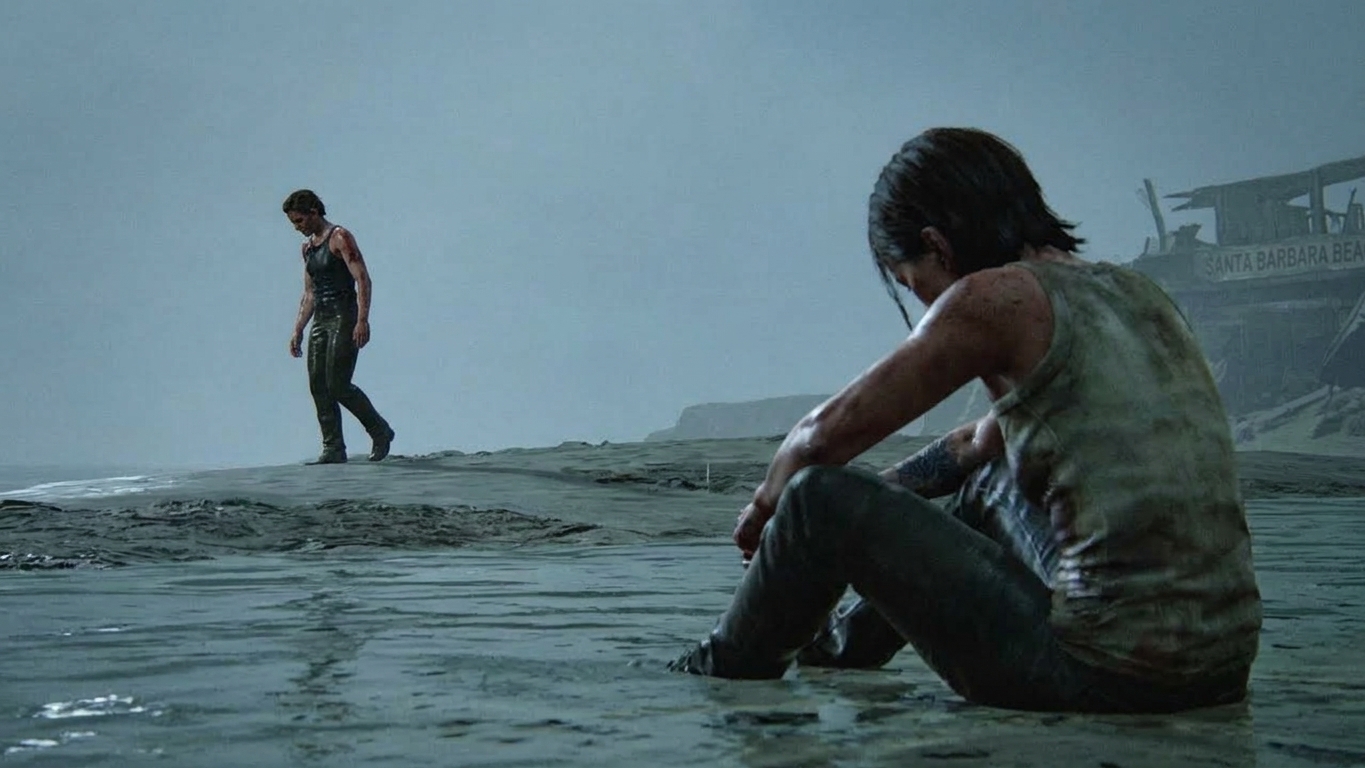
The final stretch in Santa Barbara takes this moral thesis to its bleakest conclusion. Both Ellie and Abby have paid a devastating price for their choices: Abby loses all her friends and her community and is subjected to physical torture and captivity; Ellie gives up the chance at a quiet life with Dina and JJ to chase a ghost of guilt that won't let her breathe. The final duel in the water is not an epic battle like Kratos against the gods; it is a pathetic, exhausting act stripped of all glory. Two women, physically and emotionally maimed, destroy each other over the remnants of unresolved trauma.
When Ellie decides to spare Abby's life at the last moment, after recalling the image of Joel sitting on the porch seeking to reconcile with her, there is no triumphant victory. Ellie returns to an empty house, unable even to play the guitar Joel gave her because she lost fingers in the fight. The Last of Us Part II thus completes its moral journey: revenge does not dignify, violence does not heal grief, and blind attachment to the past leaves only a trail of pain, blood and tears. It is a work that elevated video games by showing that empathy is not a comfortable narrative device, but a painful and deeply human exercise.
The enduring value of The Last of Us Part II lies in having shown that big-budget (AAA) video games can behave like great cinema or literary fiction: uncomfortable, complex and unafraid to divide opinion. It broke the notion that video games exist solely to entertain or to give the player a power fantasy, proving that they can also be spaces to explore human misery, guilt, reconciliation and punishment.
Years after its release, Naughty Dog's work remains a cornerstone in the debate over the maturity of the medium. It reminded the industry that true technological and gameplay innovation reaches its full potential when it serves a bold, honest and uncompromising artistic vision.