ForTy, DeepMind's AI that compares identical forests from space based on their history
Google DeepMind has unveiled ForTy, a system built on AlphaEarth Foundations that analyzes years of satellite imagery across 1.7 million sites to support deforestation-free supply chains.
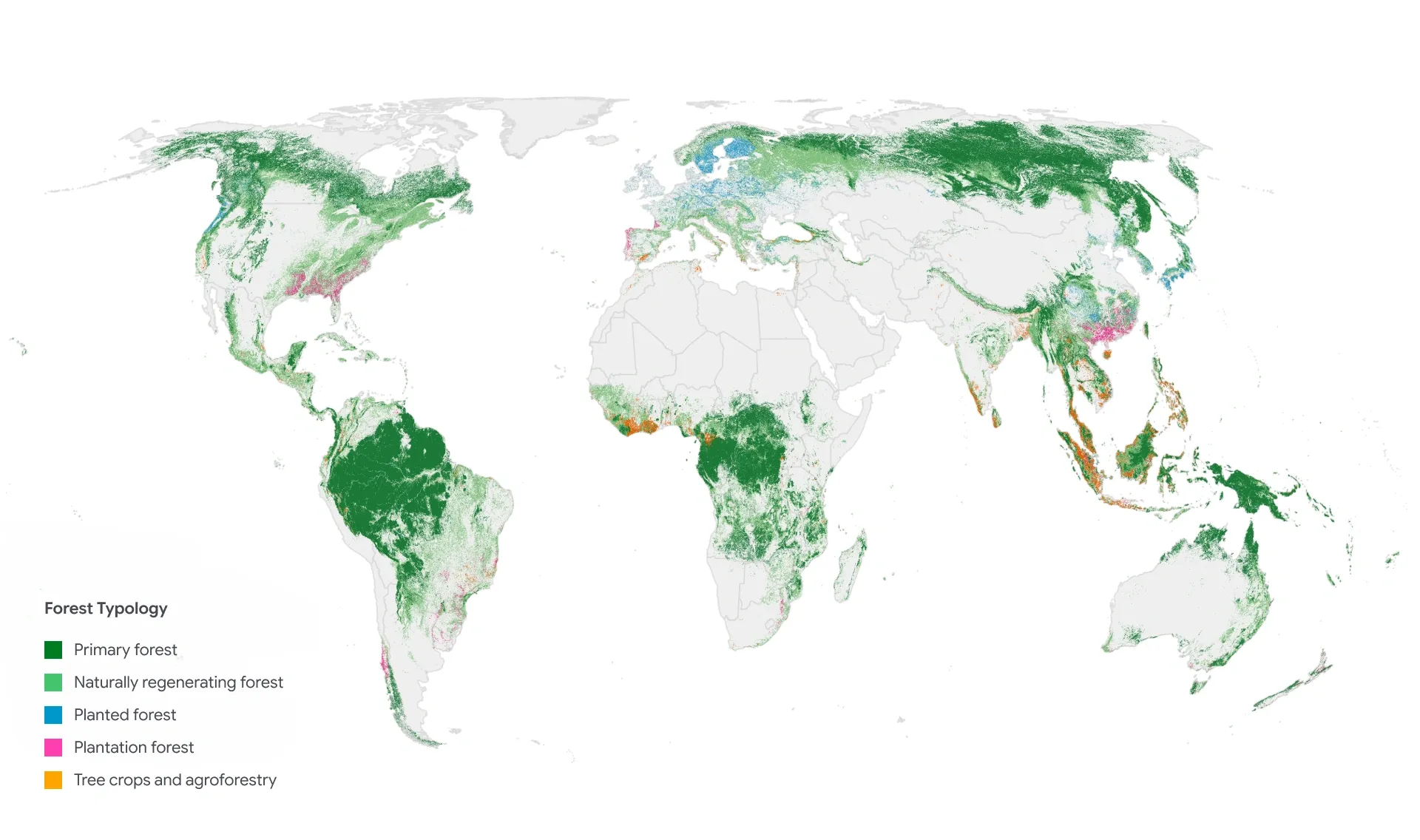
https://deepmind.google/blog/beyond-tree-cover-mapping-the-worlds-forest-types/?utm_source=x&utm_medium=social&utm_campaign=&utm_content=
From the sky, two forests can look the same: the same green, the same canopy density. Yet one may be a jungle that has stood for centuries, and the other a plantation or land that was recently replanted. With that problem as its starting point, Google DeepMind announced on October 22, 2026, a tool called ForTy that, rather than looking at a single image, observes how each site has changed over time.
According to the post the company published on its X account, ForTy reads years of satellite imagery across 1.7 million sites. The idea is that a piece of land's history, not just its current appearance, makes it possible to distinguish between forests that look alike but have followed different trajectories.
The system is built on AlphaEarth Foundations, which DeepMind describes as its foundation AI model for planetary data. A foundation model is a system trained on large volumes of information to serve as the basis for more specific applications, and ForTy would, according to that description, be one of them.
The stated goal is to help governments, companies, conservation organizations and scientists build deforestation-free supply chains. In other words, to be able to show that the raw materials reaching the market do not come from land where forests were cleared. To verify that, knowing what used to be on a piece of land is as important as knowing what is there now.
The announcement, however, is brief and leaves several questions open. The post does not explain how ForTy is trained or evaluated, nor does it provide accuracy figures. It also does not clarify whether it will be publicly available, under what access or licensing terms, or which regions or forest types those 1.7 million sites cover. Nor does it mention any Latin American countries.
For now, what can be verified is the proposal: moving from a snapshot to a historical series to understand forests. It remains to be seen whether DeepMind will publish the method and usage restrictions, and whether organizations or companies, including those in Latin America, where deforestation weighs heavily on the commodities trade, will be able to test it and independently check its results.
Source: Google DeepMind on X