NVIDIA commits $250 million in compute and adds five British startups to its portfolio
NVIDIA announced a five-year compute commitment for AI agent safety research in the United Kingdom, new planned investments in five startups and a list of deployments in healthcare, banking and quantum computing.
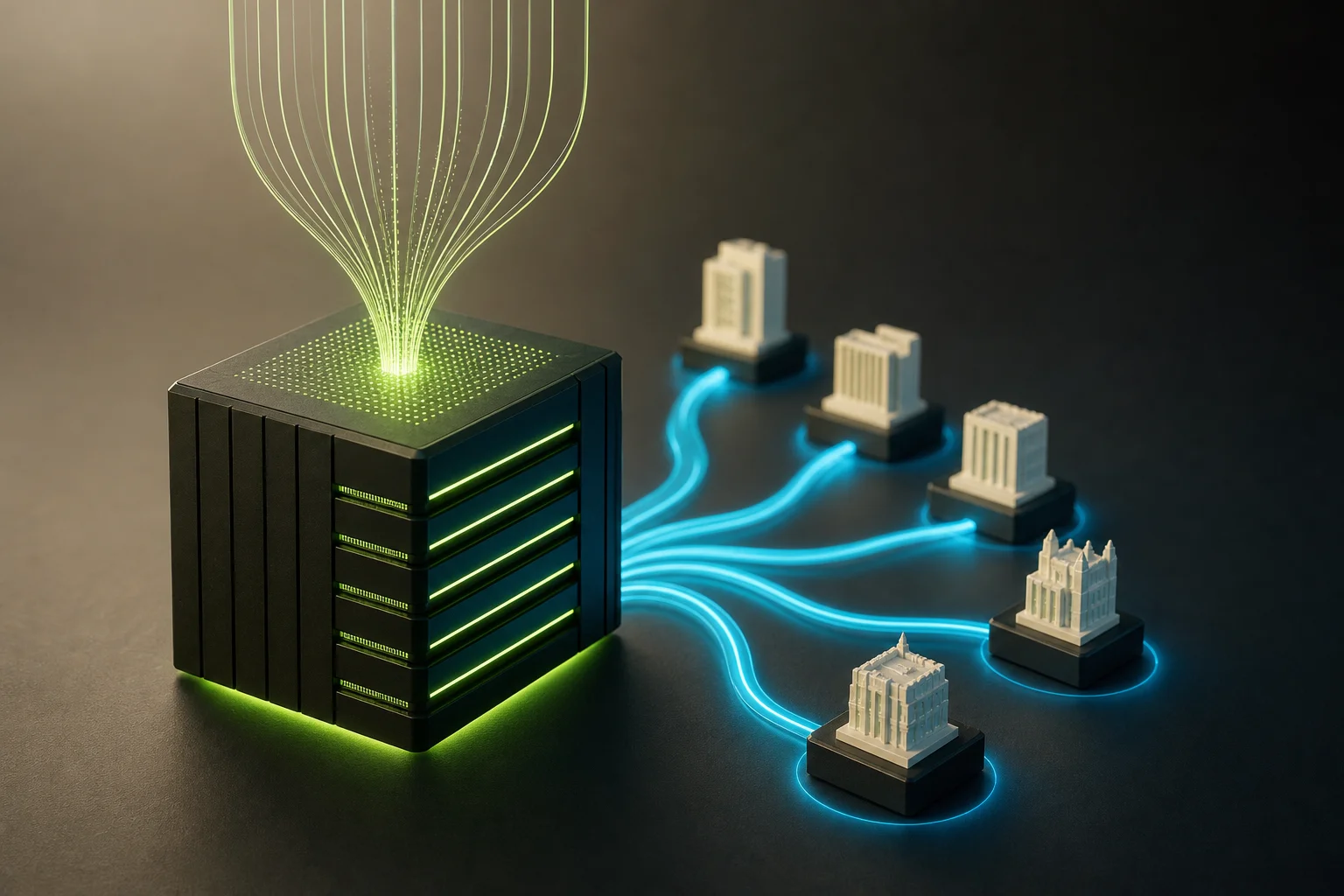
When a chip company talks about "putting the whole stack to work" (from hardware to software and models), it is usually selling an idea: that AI is no longer an experiment but infrastructure. That is what NVIDIA does in an announcement published on its blog on October 14, 2026. The announcement focuses on the United Kingdom and combines money, compute and a long list of use cases.
The most striking figure is a five-year, $250 million compute commitment to strengthen British research into the safety of AI agents, meaning systems that carry out tasks on their own. The text does not specify who will receive those resources or how they will be allocated, and it refers to compute, not cash.
The company adds that it announced new planned investments in five startups: Boltz, Foresight, Hiverge, Prima Mente and Riverlane. No amounts or terms are disclosed. They join others that NVIDIA says it has previously backed, such as Basecamp Research, Ineffable Intelligence, Synthesia and Wayve.
The profiles of the five show where the company is looking. Boltz, based in London and founded by MIT researchers, develops biomolecular models and agents to predict structures and interactions and to design potential drugs. Prima Mente builds biological foundation models to study Alzheimer's, Parkinson's and ALS. Hiverge, based in Cambridge, created a "discovery engine" that automatically writes and optimizes algorithms. Foresight helps owners of large construction projects, including data centers, anticipate completion dates. And Riverlane, also in Cambridge, works on real-time error correction for quantum computers. NVIDIA is also joining the Earthshot Prize as a founding partner of its Global Alliance, contributing compute and technical expertise to climate projects.
From labs to banking
The second half of the announcement is a catalog of deployments, all described by NVIDIA or its partners and without independent verification in the text. In energy, Fuse Energy is moving its customer service AI to its own infrastructure with B300 Blackwell Ultra GPUs and says it serves more than 450,000 households. In healthcare, OneAdvanced is presenting what it calls the first and most advanced language model fine-tuned for primary care triage, built with NVIDIA's Agent Toolkit and open models, for patients of the public NHS system. Heidi is integrating the open Nemotron models, and Speechmatics is deploying Oak, a multilingual medical speech recognition model that lets organizations control where patient audio is processed.
In laboratories, Danaher describes an AI-powered autonomous lab "designed to" accelerate the discovery of affinity reagents by up to 8 times, built on the open BioNeMo models. This is a design goal, not a measured result.
In finance, the announcement lists Revolut, with PRAGMA, a foundation model pretrained on 26 million anonymized histories; Lloyds, with ATUM, which turns billions of transactions into reusable AI; Starling, which is training a model on Civo's sovereign cloud; NatWest, which is exploring Nemotron Voice; and Modulr, which uses agents for parts of its payment operations. LSEG and NVIDIA are also bringing GPU-accelerated market analytics to global institutions.
On the quantum front, Riverlane is showing how GPUs speed up decoder recalibration, and ORCA Computing presented its PT-3 photonic accelerator, which according to the company improved the identification of useful proteins by 20% with a hybrid quantum-classical approach using the Proteina model. That figure comes from the company itself, with no independent testing in the material. NVIDIA adds that more than 3,100 British companies are part of its Inception program for startups.
For Latin American readers, the announcement serves above all as a map of how NVIDIA combines investment, compute and open models to tie local ecosystems to its platform. It remains to be seen how much of this translates into measurable results and whether it will be replicated outside the United Kingdom. The next clue will come on Wednesday, October 21, at 11 a.m. Central European Time, with Jensen Huang's keynote at GTC Berlin.
Source: NVIDIA AI