Andromeda over the hills of Australia: NASA's picture of the day
NASA's Astronomy Picture of the Day shows Andromeda, our large neighboring spiral galaxy, rising over the hills of New South Wales in the middle of the southern spring. In the sky, the galaxy spans nearly six full moons.
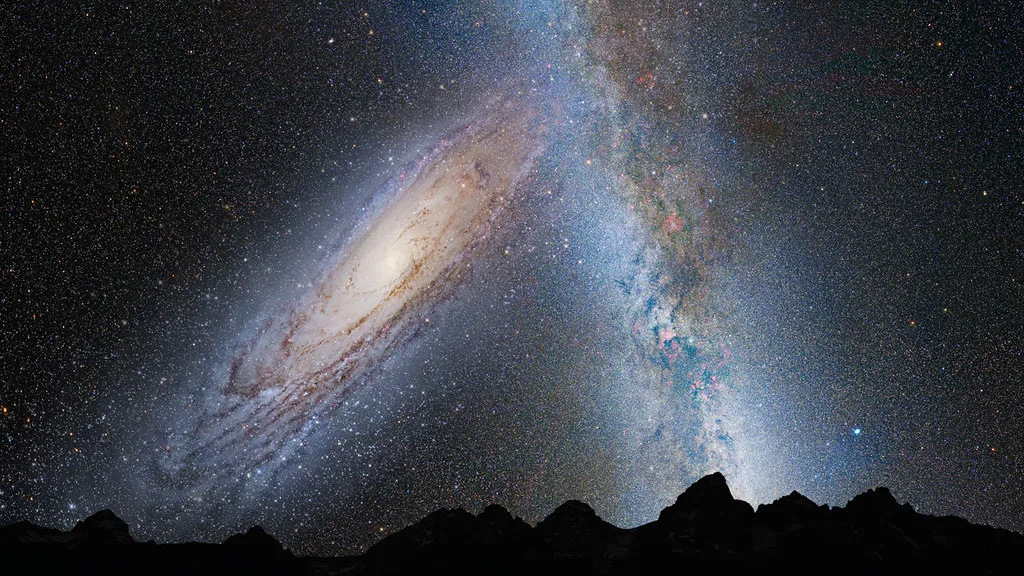
Photo: NASA Goddard Photo and Video · CC BY 2.0 · via NASA
From Mullion, in New South Wales (Australia), looking north to find the Andromeda galaxy is an exercise in patience: it never rises more than a few degrees above the horizon. Even so, photographer Lucy Yunxi Hu managed to capture it climbing above some hills, and her image was selected by NASA as the Astronomy Picture of the Day (APOD) for October 23, 2026.
The shot was taken on the night of October 10–11. According to the explanation accompanying the image, during the Southern Hemisphere spring Andromeda reaches its highest point around midnight, and that is the moment the scene captures. It is a telephoto image, meaning it was taken with a lens that brings distant objects closer, and a composite of multiple exposures.
The APOD text describes the process: the frames were digitally tracked and stacked, a technique that combines many captures of the same patch of sky to bring out very faint details, and were then blended with a shot of the landscape. The result, described as a deep-sky astrophotographic composite, reveals the galaxy's greater extent in the Earth's night sky.
Andromeda, also known as M31, is one of the brightest galaxies in the Messier catalog, the list of celestial objects compiled by astronomer Charles Messier. Even so, to the naked eye it appears only as a small, faint, diffuse smudge. The image works precisely through that contrast: what the eye can barely make out shows clear structure here. According to APOD, this spiral, the nearest large galaxy to our own, spans nearly six full moons in the sky.
NASA's note is a description of a photograph, not a new scientific discovery: it presents no measurements or research results, and the material provides no details about the equipment or camera used.
For readers in Latin America, the image serves as an invitation to look up at the sky: the original page notes that APOD publishes a different image every day with a brief explanation written by a professional astronomer. The next one, according to the site itself, will be "Rosetta's Selfie," scheduled for October 24.
Source: NASA News