Robots that walk on a fungus's electrical signals: what Cornell achieved and what is still a promise
Cornell researchers connected living mycelium to two robots, got them to move using its electrical impulses, and made them react to ultraviolet light. Measuring soil in crop fields is, for now, only a plan.
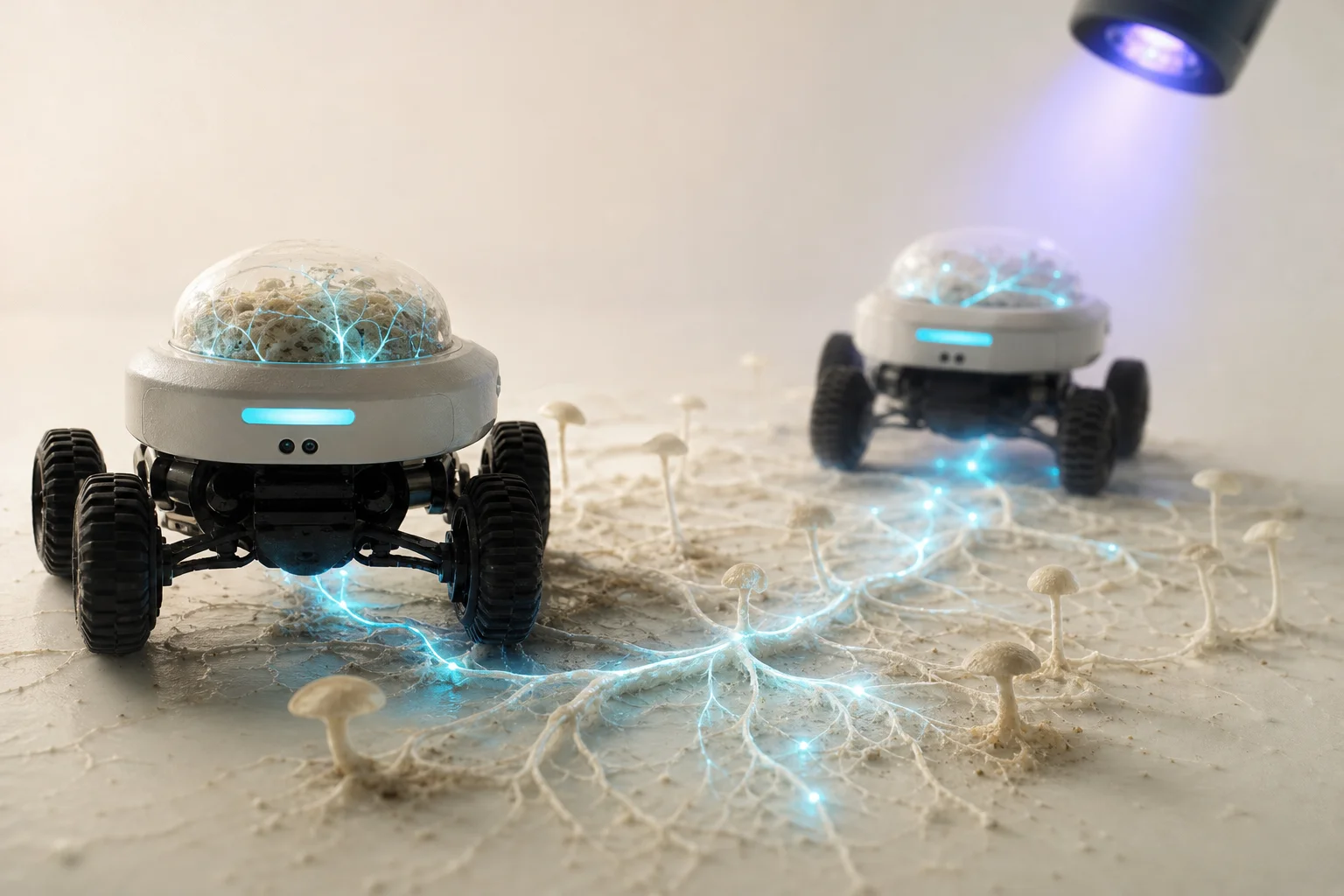
Building a robot takes time, technical skill, good materials and, sometimes, a bit of fungus. According to the Cornell Chronicle, researchers at Cornell University grew an unusual component, more at home on the forest floor than in a lab: mycelium, the vegetative, underground part of fungi. Using its natural electrical signals, they were able to control two "biohybrid" robots, that is, machines that combine electronics with living tissue.
The paper, titled "Sensorimotor Control of Robots Mediated by Electrophysiological Measurements of Fungal Mycelia," was published on August 28 in the journal Science Robotics. Its lead author is Anand Mishra, a research associate in the Organic Robotics Lab, which is led by Rob Shepherd, professor of mechanical and aerospace engineering at Cornell and the paper's senior author.
How to "listen" to a fungus
The idea starts from a known limitation. Engineers often draw inspiration from animals, and some robots already incorporate living material, such as muscle tissue cells, but those biological systems are difficult to keep healthy and functional. Mycelium, according to the article, grows in harsh conditions and can sense chemical and biological signals and respond to multiple stimuli.
Mishra's system has two parts: an electrical interface that blocks vibration and electromagnetic interference and records the mycelium's activity in real time, and a controller inspired by central pattern generators, a type of neural circuit. In practice, it reads the raw signal, identifies the fungus's rhythmic spikes and converts them into a digital control signal that is sent to the actuators, the components that move the robot.
With that, two machines were built: a spider-shaped soft robot and a wheeled robot. The team ran three experiments. In the first, the robots walked and rolled in response to the mycelium's natural continuous spikes. In the second, ultraviolet light made them change their gait, which, according to the team, shows that the fungus reacts to its environment. In the third, the researchers were able to completely override the mycelium's native signal.
The project required expertise in mechanics, electronics, mycology, neurobiology and signal processing. Mishra worked with Bruce Johnson, of neurobiology, who taught him how to record the signals, and with Kathie Hodge, of plant pathology, who taught him how to grow mycelium without contamination, a challenge when electrodes are stuck into a fungus.
From the lab to the field: still a projection
The agricultural angle comes from Shepherd. He says light was the input used in this case, but that in the future it will be chemical, and suggests that robots like these could measure soil chemistry in crop fields and decide when to add fertilizer, potentially mitigating effects such as harmful algal blooms. This is a projection, not a result: the only input tested was light.
The page also does not specify the fungal species, the magnitude of the signals, the response times or how long the mycelium lasts in operation, and the material includes no independent evaluation; everything comes from Cornell and the team. The research was supported by the NSF CROPPS Science and Technology Center, the USDA National Institute of Food and Agriculture and the NSF Signal in Soil program.
For Latin America, where agriculture carries significant weight in the economy, the idea is interesting, but the road looks long: there are no timelines, costs or versions outside the lab. It is worth watching whether the team manages to move from light to chemical sensing, and reading the full paper in Science Robotics.
Source: Biohybrid robots controlled by electrical impulses — in mushrooms — Cornell Chronicle