A "haunted" universe: dark matter seen in a simulation that is NASA's Astronomy Picture of the Day
NASA's Astronomy Picture of the Day shows a simulation in which dark matter stretches across the cosmos like black cobwebs. It offers a way to see what no telescope can capture directly.
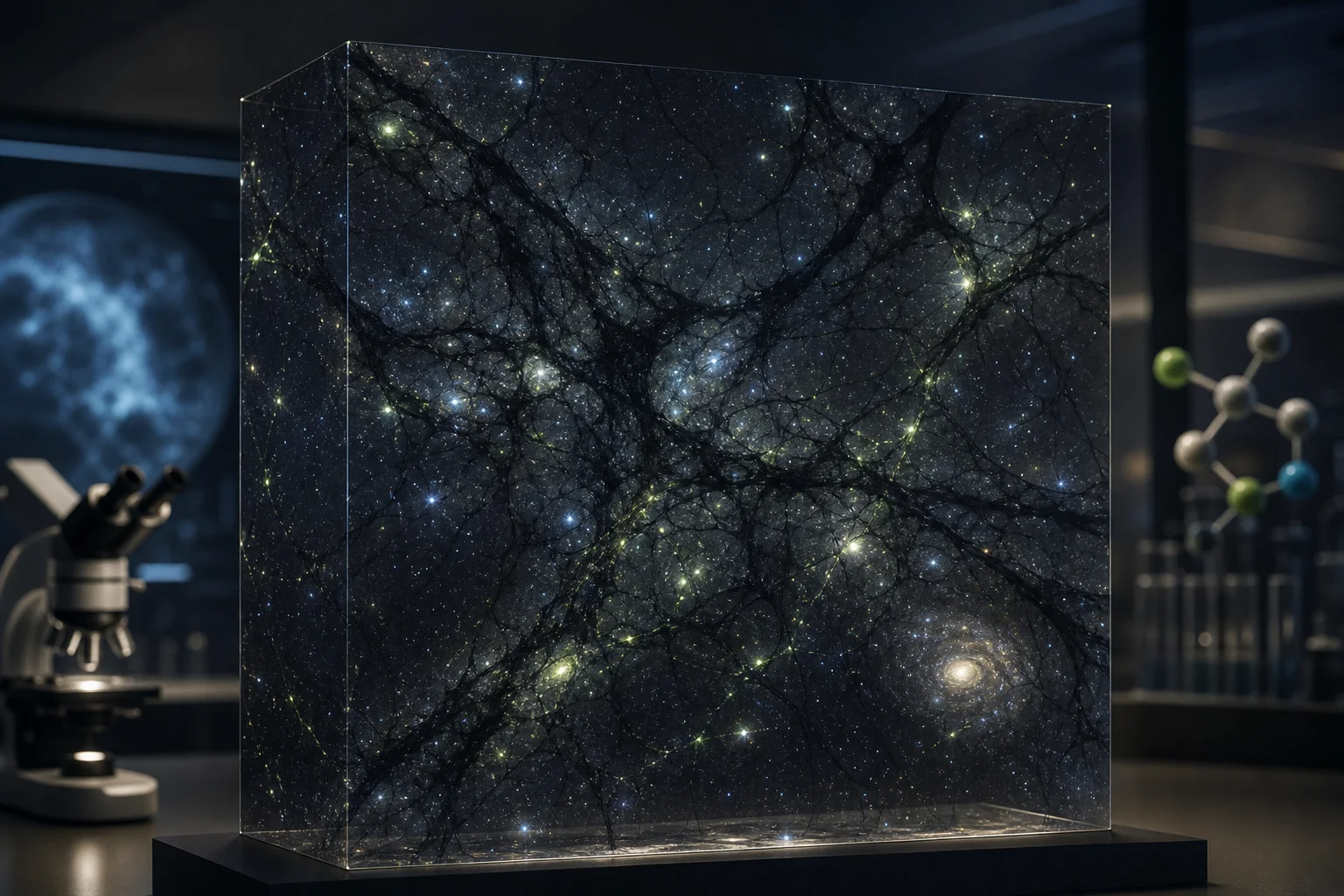
What if the universe were haunted? NASA poses the question in its Astronomy Picture of the Day (APOD) for October 25, 2026, which shows a dark, almost ghostly map crisscrossed by black, cobweb-like filaments. It is not a telescope photograph but a frame from a computer simulation.
The image comes from *Dark Universe*, a show at the Hayden Planetarium of the American Museum of Natural History (AMNH) in New York. In the frame, filaments of dark matter appear in black and stretch across all of space. The sparse concentrations of baryonic matter, the "normal" matter that stars, planets and people are made of, appear in orange. The credit goes to Tom Abel and Ralf Kaehler of KIPAC at SLAC, and to the AMNH.
The APOD explanation recalls why astronomers turn to this invisible substance. The gravity of dark matter is the leading explanation for why galaxies spin so fast, why they orbit so quickly within clusters, why gravitational lenses deflect light so strongly, and how visible matter is distributed. A gravitational lens occurs when the gravity of a massive object bends the light passing near it.
The text adds an important nuance about the value of these simulations: according to APOD, they are good statistical matches to astronomical observations. In other words, this is not an imaginative drawing but a representation that reproduces, in statistical terms, what is observed in the sky. Even so, the note itself acknowledges that dark matter is "pretty strange" and that its form is unknown.
The note ends with a twist: dark matter is no longer considered the strangest source of gravity in the universe. That title has passed to dark energy, described as a more uniform source of repulsive gravity that now appears to dominate the expansion of the entire universe. The text does not go into further detail about its nature.
For readers in Latin America, the entry serves as a simple gateway to one of the great mysteries of cosmology, with an image that helps visualize the invisible "web" on which matter is organized. What remains unresolved, as APOD itself notes, is figuring out what dark matter really is. The series continues tomorrow with a new image, titled *Orion the Great*.
Source: NASA News